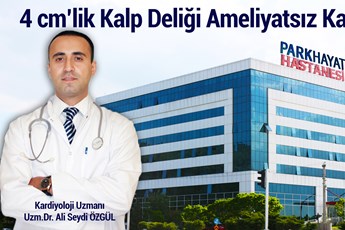
4 CM HEART HOLE CLOSED WITHOUT SURGERY
Uğur Akbaş, a 50-year-old resident of Akşehir, had been complaining of constant fatigue and weakness that had recently progressed to the point of reducing his quality of life. After examinations and tests at the hospital where he first applied, Akbaş was told that he needed open heart surgery. Explaining the diagnosis and treatment process afterwards, Uğur Akbaş said, "Although I had a heavy job in my daily life, I did not feel any symptoms of the hole in my heart. But recently, I applied to the hospital because I became unable to take steps. After my examination, it was revealed that I had a hole in my heart as well as my lung disease. I was told that I needed open heart surgery. I did not want to have this surgery. Since the hole in my heart was extremely large, we started to search for different treatments and hospitals instead of open heart surgery. As a result of our research, I decided to apply to cardiology specialist Dr. Ali Seydi Özgül, who I learned that he was very successful in these matters. After the necessary examination, tests and examinations were performed, my operation was performed with the percutaneous ASD closure method. I feel much better now. The closure of such a large heart hole without surgery shows how far medicine and technology have advanced. I would like to thank all PARKHAYAT employees, especially my physician Dr. Ali Seydi Özgül, who successfully performed my operation, may God bless them all. " he said.
"We closed the hole with percutaneous ASD closure method."
PARKHAYAT Hospital cardiology specialist Dr. Ali Seydi Özgül, who performed the operation: "When Uğur Akbaş applied to us, he stated that he had complaints of not breathing and constant fatigue. Our patient said that he came to our hospital with the hope of closing the hole in his heart without surgery. After the examination with the endoscopic echocardiography device (TEE), we detected a heart hole close to 4 cm, which is very difficult to close. We also detected high pulmonary blood pressure during the examination. It becomes much more difficult to perform this procedure on patients after a certain blood pressure level. By taking our patient to the angiography unit, it was planned to close the hole in his heart with the Percutaneous ASD Closure Method. At the end of the successful operation, the hole in our patient's heart was closed and he regained his health."
Cardiology specialist Dr. Ali Seydi Özgül emphasized that they used the largest ASD device to be used during the operation and said, "After the closure of our patient's heart hole, we saw that his pulmonary pressure also improved. Our patient will no longer suffer from fatigue, weakness or shortness of breath. He will lead his life more easily."
4 CM HEART HOLE CLOSED WITHOUT SURGERY Galeri